Calls for action rather than more promises are mounting after President Cyril Ramaphosa unveiled a four-part action plan aimed at tackling South Africa’s gender-based violence and femicide (GBVF) crisis.
The discovery of 12 women’s bodies in Gauteng over the past two months has prompted the President to announce measures.
Eleven of the bodies were discovered in parts of Ekurhuleni, while another was found at a dam in Soweto.
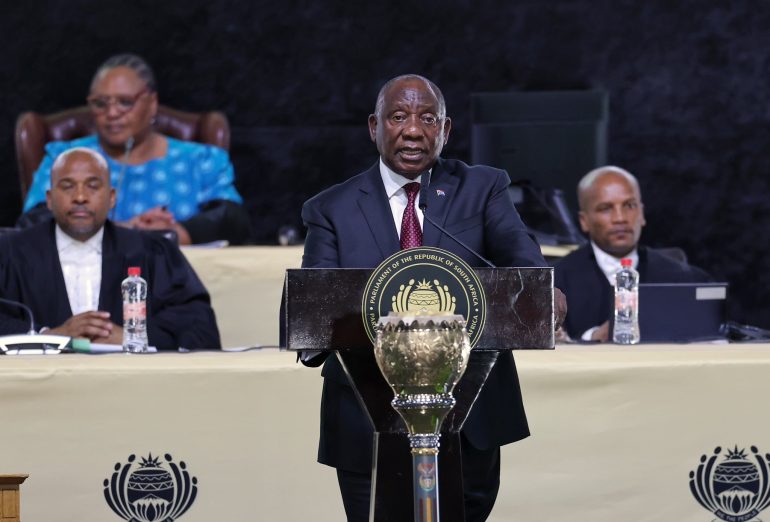
Addressing the nation on Tuesday night, Ramaphosa directed the Ministers of Police and Justice, working with the South African Police Service (SAPS) and the National Prosecuting Authority (NPA), to undertake a national case-recovery operation focused on unresolved murders, attempted murders, rapes and serious sexual offences involving women and children.
The President also ordered the development of a funded plan to reduce forensic backlogs and establish clear turnaround standards for priority gender-based violence and femicide cases.
Municipalities have also been directed to identify unsafe areas and address harmful substance abuse.
“Within sixty days, these audits must identify broken streetlights, overgrown public spaces, abandoned buildings, unsafe transport routes and facilities, poorly secured parks and other conditions that place women at risk.”
“Within 90 days of completing the audit, the most urgent hazards must have been addressed or included in a funded implementation plan with clear completion dates,” Ramaphosa added.
“The results of the audits and progress in correcting the identified hazards will be published so that communities can see what has been identified, what has been fixed and what remains to be done. “
Ramaphosa said women should not have to reorganise their lives around the threat of male violence.
I have directed the Minister of Police, the National Commissioner of Police and the relevant forensic authorities to present, within 60 days, a funded plan to reduce forensic backlogs and establish clear turnaround standards for priority gender-based violence and femicide cases.…
The President’s address has drawn criticism from various organisations and political parties.
Forum for South Africa (FOSA) says it is concerned that the President’s GBVF intervention offers little that is fundamentally new.
FOSA leader, Tebogo Mashilompane, says it’s time to move beyond announcements and take decisive action to close loopholes in the country’s laws.
“President Ramaphosa has acknowledged that the government’s efforts have not been enough. We agree. However, acknowledging failure must be followed by measurable action, meaningful legal reforms and consequences for officials who neglect their responsibilities.”
South Africa does not need more promises. It needs action, stronger laws and a justice system that protects women before it is too late.”
Mashilompane has also added to calls for stronger enforcement of protection orders, faster processing of forensic evidence and accountability for police officers who fail to properly investigate reported cases.
play_arrow
‘Action, not promises’ as pressure mounts over GBVF crisisLindiwe Mpanza
Meanwhile, Activists and Citizens Forum has called for an overhaul of the criminal justice system.
The organisation’s, Dennis Bloem, says perpetrators of GBV must not be treated with kid gloves.
“The President has said nothing new. It is very disappointing that he is talking about high grass, dirty cemeteries, street lights and other things that are known to all of us. These are things that we see every day.
“We expected to hear the President telling the country about immediate action that will be implemented tomorrow, but the President is telling us that he wants to see results in 90days. The question that we are asking is about tomorrow. Will women be safe?”
ActionSA leader, Herman Mashaba, says Ramaphosa’s address was a belated attempt to respond to the consequences of the government’s failure to build a criminal justice system that protects South Africans.
Mashaba says victims are often subjected to secondary violence by the very justice system meant to protect them.
“Until government addresses the institutional failures that allow cases to be lost, investigations to stall and victims to be failed, South African women and children will remain vulnerable to both the initial act of violence and the secondary violence inflicted by a system that is supposed to protect them.”
Adding his voice, DA leader, Geordin Hill-Lewis, says no South African woman should have to plan her ordinary daily life around the possibility that she may be attacked or killed.
Hill-Lewis says Ramaphosa has been announcing emergency responses to GBVF since 2019.
“There has been an Emergency Response Action Plan, a National Strategic Plan, successive multi-billion-rand funding commitments, new legislation, summits, a statutory Council, and finally the classification of GBV and femicide as a national disaster in November last year.
“But eight years into this presidency, there is a recurring gap between what is announced and what women experience in their communities.”
Meanwhile, the Economic Freedom Fighters (EFF) says South Africa does not suffer from an absence of information about GBVF, but rather from what it describes as a failure of political will, institutional capacity, and accountability.
The party says the women murdered in Ekurhuleni were not isolated victims, arguing that their deaths occurred within a country where women continue to face sexual violence, domestic violence, rape, abduction, and murder.
“The EFF therefore rejects the notion that the killings in Ekurhuleni represent a moment requiring the government to discover the scale of GBVF. The scale of the crisis has been known for years, as have many of the institutional weaknesses responsible for the failure to protect women and prosecute perpetrators. What has been lacking is sustained implementation, adequate resources, effective coordination, and political accountability.”
The EFF’s Statement on President Ramaphosa’s Address on Gender-Based Violence and the Killings of Women in Ekurhuleni
-The women murdered in Ekurhuleni were not isolated victims. Their deaths occurred within a country where women face persistent sexual violence, domestic… pic.twitter.com/SFKCqXI2Ez
 play_arrow


 play_arrow