-
 play_arrow
Y WORLD Radio Station Y WORLD RADIO
music_note

Mystery ‘scrubs’ substance sparks concern at Gauteng schools
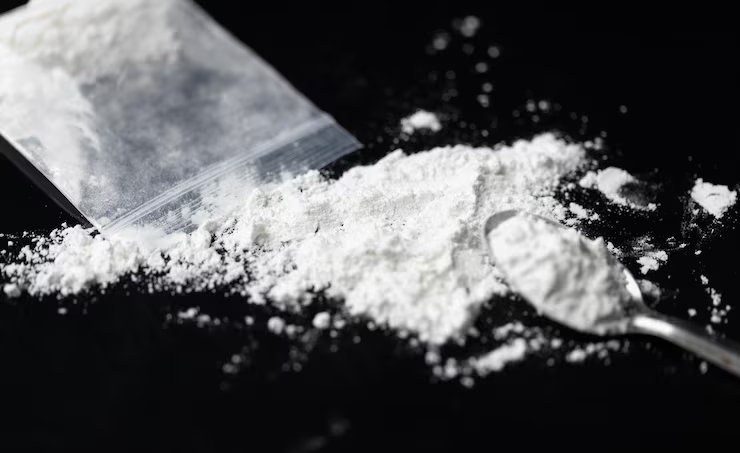
The Gauteng Education Department has expressed concern over a mystery powder known as “scrubs” making its way into some school communities.
The colourful powdered substances are reportedly being bought by learners from spaza shops and local vendors, with some pupils allegedly sprinkling them onto meals served at schools through the government’s National School Nutrition Programme (NSNP)
The department says the contents and safety of the powders remain unclear, prompting calls for urgent intervention from police and food-safety authorities.
Gauteng Education MEC, Lebohang Maile, says he is frustrated by what he describes as the slow pace of investigations.
Maile has also taken aim at businesses over irresponsible waste disposal, warning that materials never intended for human consumption could end up in communities and eventually make their way into schools.
“It is reckless for any business to dispose of its waste in a manner that allows materials which are not intended or safe for human consumption to find their way into our communities and ultimately into our schools. Businesses must take responsibility for how their waste is handled from the point of disposal to its final destination,” Maile said.
The department has now made its position clear: “scrubs” are not part of the NSNP and may not be added to school meals.
Schools have been instructed to monitor meal-serving and eating areas, while any incidents involving the powders must be reported immediately.
The department says fact-finding visits found schools were complying with the programme’s food requirements, with no evidence that the externally purchased powders formed part of the official school meals.
The National School Nutrition Programme provides breakfast and lunch to more than 1.7 million learners across 1,675 Gauteng schools, with about R1.69 billion allocated to the programme for the 2026/27 financial year.
“For the 2026/27 financial year, approximately R1.69 billion has been allocated to the programme. Approximately R1.2 billion is funded through the National School Nutrition Programme Conditional Grant, with the balance funded through the provincial equitable share,” the department said.
“At a high level, approximately R861.6 million is allocated to primary schools, R561.6 million to secondary schools, R37.3 million to Learners with Special Education Needs schools and R206.4 million to food handlers.”
Maile is now calling on parents, schools, businesses, communities, law enforcement agencies and food-safety authorities to remain vigilant.
He says everyone has a role to play in ensuring that what children are consuming at schools is safe.
“We call on School Governing Bodies, parents, educators, learners, food handlers, law-enforcement agencies, environmental-health authorities, businesses and communities to remain on high alert regarding all matters that may compromise the safety and wellbeing of learners,” Maile said.
“Education requires a social compact. Government and schools cannot confront every social challenge alone. It takes a village to raise a child. Parents, School Governing Bodies, communities, businesses, law-enforcement agencies and government all have a responsibility to protect our children and ensure that schools remain safe environments for teaching and learning.”
MEDIA STATEMENT | MEC Maile Calls for Swift Action to Protect Learners from Potentially Hazardous Substances
Gauteng MEC for Education, Sport, Arts, Culture & Recreation, @LebogangMaile1, has called for urgent intervention following concerns over potentially hazardous products,… pic.twitter.com/b42bFGK7h1
— Gauteng Department of Education (@EducationGP1) October 1, 2026
Written by: Odirile Rabalao

Current show
Upcoming shows
Latest posts
LATEST NEWS

Bullring confirmed as 2027 CWC final host
Mystery ‘scrubs’ substance sparks concern at Gauteng schools

Mogotsi defence demands cellphone records as trial preparations are delayed

Mudzinganyama granted R15k bail in Vlamo Restaurant intimidation case

Shell South Africa V-Power Ultimate VIP Experience Competition
SPOTLIGHT FEST