-
 play_arrow
Y WORLD Radio Station Y WORLD RADIO
music_note

Senzo Meyiwa Trial | Cellphone records come under scrutiny

Cellphone records allegedly linking accused number five, Fisokuhle Ntuli, to other accused men in the Senzo Meyiwa murder trial have come under renewed scrutiny, with a Vodacom expert raising questions over some of the records presented in court.
Vodacom cellphone data expert, Tsolanang Golele, confirmed that a number allegedly used by Ntuli on the day Meyiwa was killed received a call from a number Ntuli says belonged to a woman known as “Ms Madladla”.
But Golele stressed that he could not independently verify who was actually using the cellphone at the time.
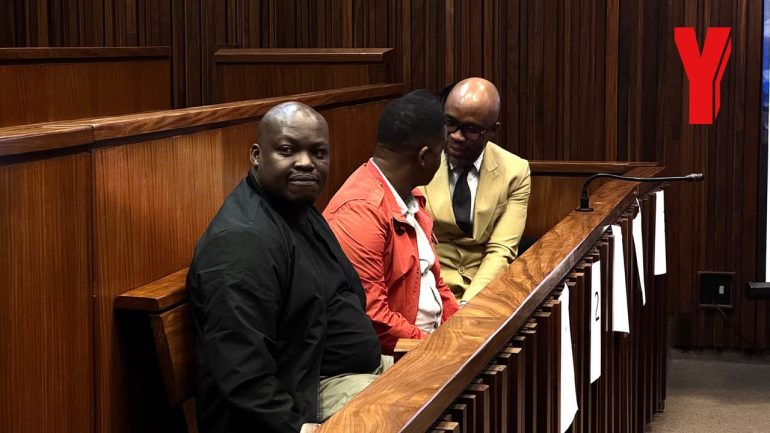
He concluded his testimony on Monday at the Pretoria High Court, where five men are standing trial for the murder of former Bafana Bafana captain and Orlando Pirates goalkeeper, Senzo Meyiwa.
Meyiwa was shot and killed on 26 October 2014 while visiting his then-girlfriend, Kelly Khumalo, at her family home in Vosloorus.
While no eyewitness has directly placed Ntuli inside the house that night, the State has relied heavily on cellphone data and communication records to build its case.
Previous experts, including Colonel, Gideon Gouws and Lambertus Steyn, testified about calls allegedly linking Ntuli to accused number three, Mthobisi Mncube, accused number one Muzi Sibiya and accused number two, Bongani Ntanzi.
The State argues the communication contradicts the accused men’s claims that they did not know one another before their arrests.
During cross-examination, defence counsel, Zandile Mshololo, questioned Golele about the “Ms Madladla” call, which was allegedly received by Ntuli’s cellphone hours before Meyiwa’s murder.
Golele confirmed that the call appeared on the relevant cellphone records.
-
 play_arrow
Senzo Meyiwa Trial | Cellphone records come under scrutiny Nonhlanhla Harris
The defence also challenged the State’s interpretation of a call allegedly exchanged between Ntuli and Khumalo in August 2014.
The State had presented the call as having taken place on 2 August, but the defence argues it was actually made on 3 August.
The dispute centres on Vodacom’s time records, with the court hearing that two hours must be added to the recorded times to establish the actual time of a call.
Steyn previously testified that Ntuli’s cellphone received a 110-second call from a number linked to Khumalo at around 10:40pm on 2 August 2014, while the cellphone was connected to a Kimberley tower.
He also testified about another call between the numbers on 15 October, just 11 days before Meyiwa’s death.
Defence counsel, Sipho Ramosepele, argues the two-hour adjustment means the disputed August call should instead be dated 3 August.
“The analyst here in court did not say that the court was made on the 3rd of August. He said the court was made on the 2nd of August. So if we add the two hours, we are then off, in terms of the analysis that he has done,” Ramosepele said.
Judge Ratha Mokgwatlheng stepped in to settle the dispute, saying he remembered Steyn correcting himself after initially failing to point out the time adjustment in his analysis.
But another twist emerged when Golele distanced himself from cellphone records marked A3 and A4, documents the State had intended to rely on during his testimony.
Golele told the court that he could not locate the records on Vodacom’s system despite searching through data dating back to 2014.
He said the documents also lacked case numbers and the Vodacom emblem, features he described as standard on official records issued by the network.
-
play_arrow
Senzo Meyiwa Trial | Cellphone records come under scrutiny Nonhlanhla Harris
Golele urged the court to trace the documents back to whoever originally supplied them, saying that person would be best placed to explain their contents.
He suggested that either the defence or prosecution may not be presenting the full picture, while firmly maintaining that he should not be associated with the disputed records.
The cellphone evidence remains a key battleground as the State attempts to piece together the alleged network of communication surrounding Meyiwa’s murder.
Written by: Odirile Rabalao
Current show
Upcoming shows
Latest posts
LATEST NEWS

Zungu accepts defeat, but still wants change
Senzo Meyiwa Trial | Cellphone records come under scrutiny

Ramaphosa calls for AI oversight as Trump insists US must win AI race

Matlala Trial | Fortuner tracking data under fire as defence challenges State’s case

Family confirms body found in Rhodesfield is missing runner Tsontso
SPOTLIGHT FEST