-
 play_arrow
Y WORLD Radio Station Y WORLD RADIO
music_note

Madlanga Commission | Commissioner Spies says EMPD needs tighter vetting systems

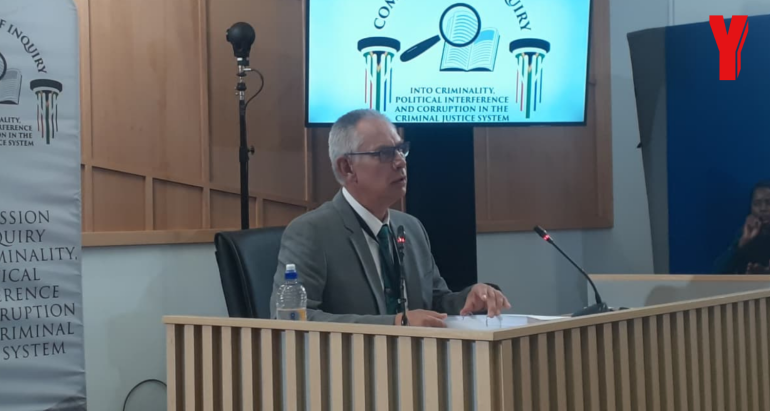
Former Ekurhuleni Metro Police Chief, Revo Spies, has criticised the Ekurhuleni Metro Police Department’s (EMPD) for what he calls dangerously weak vetting systems that allow convicted criminals to enter — and remain within — the force.
Testifying before the Madlanga Commission, Spies said the City of Ekurhuleni’s personnel vetting system urgently needs to be overhauled, claiming that hundreds of officers facing criminal charges continue to serve in the metro police.
He further stated that around 300 of the 3,700 EMPD workers are either on trial or have already been convicted of serious offences — yet they still serve in uniform.
He said suspended EMPD Chief, Isaac Mapiyeye, had requested in December 2023 that all EMPD members undergo a comprehensive vetting process to determine their suitability for service.
However, Spies claimed that the now suspended Deputy EMPD Chief Brigadier Julius Mkhwanazi, resisted the move and allegedly attempted to interfere with the process, insisting that the officials handling the vetting could not be trusted.
Spies revealed that, according to internal records, the EMPD currently has 58 officers accused of assault, 41 of theft, 15 awaiting trial for murder, and four previously convicted of murder, among other serious crimes.
He expressed concern about the absence of clear policies disqualifying convicted individuals from serving as metro police officers.
Spies said that because only the South African Police Service (SAPS) has full access to criminal records, the EMPD often lacks crucial information about its employees’ backgrounds.
Rogue operations and use of civilians
Spies also accused Mkhwanazi and Brigadier Deon Singh of unlawfully employing civilians to perform police duties meant only for SAPS officers.
He said the EMPD leadership became aware of the civilians’ involvement only in August 2024, when the group confronted suspended chief Mapiyeye at his office — demanding promotions to the rank of wardens.
According to Spies, the civilians claimed they had been taking instructions from Mkhwanazi and Singh since 2015, conducting intelligence gathering, arrests, and other law enforcement operations.
“They are a rogue unit,” Spies testified. “There are only three intelligence structures in this country — the SSA, Military Intelligence, and Crime Intelligence. No one else can conduct intelligence operations, not even metro police. If I instruct a civilian to gather intelligence, I am rogue — and everyone involved is rogue by association,” he added.
He said it remains unclear whether these civilians were ever officially paid by the EMPD, as there are no financial records linking them to the department.
However, Spies said they often wore white shirts, black trousers, and ties — resembling EMPD’s sergeant-at-arms uniform — while allegedly operating under Mkhwanazi and Singh’s direction.
Alleged protection from senior officials
Former Ekurhuleni Municipality Director of Employee Relations, Xolani Nciza, also testified before the commission, describing Mkhwanazi’s close relationship with former municipal manager Imogen Mashazi.
Nciza said many municipal employees were cautious around Mkhwanazi because of his perceived influence and alleged intimidation tactics.
He told the commission that when the municipality decided to investigate Mkhwanazi’s conduct in the “blue-light saga” — involving alleged misuse of state privileges for Vusimuzi “Cat” Matlala’s vehicles — officials were careful not to act without consulting Mashazi.
Nciza added that EMPD HR Head Linda Gxasheka had refused to intervene in Mkhwanazi’s pending disciplinary process, allegedly telling colleagues via WhatsApp that she feared for her children’s safety.
Written by: Odirile Rabalao


Current show
Upcoming shows
Latest posts
LATEST NEWS

Proteas face mountain in Test against Australia

Alleged pastor’s rape, infant murder case postponed

A record 200,000 Gauteng candidates set to write matric exams amid high-tech cheating fears

‘Baby Nikita’ murder trial delayed again as court prioritises other case

Shadrack Sibiya resigns from SAPS amid disciplinary proceedings
SPOTLIGHT FEST